
Rethinking College Readiness, Belonging, and Institutional Responsibility
Beyond Butts in Seats: What Are We Really Measuring?
In education, the focus is often on whether students are “college ready.” From the beginning of their educational journeys, we assess, test, sort, and prepare students according to predetermined measures of readiness. By the end of high school, the central question becomes: Are these students ready for college?
But perhaps we have been asking an incomplete question. We should also be asking, “Are colleges ready for students?”
Are colleges prepared to receive students with different cultural backgrounds, learning needs, identities, financial realities, family responsibilities, and levels of academic preparation? Have institutions created environments in which students can build meaningful relationships, ask for help without shame, take intellectual risks, and see their knowledge and experiences reflected in the curriculum? Or do colleges simply admit students and expect them to adapt to systems that were not designed with them in mind?
Belonging is central to institutional readiness. Access may bring students through the door, but belonging influences whether and how they can remain, participate, grow, and thrive once they arrive. A student-ready college does more than determine whether students meet its standards. It examines its policies, procedures, everyday practices, and measurable outcomes to determine whether the institution is creating the conditions students need to succeed.
College readiness, then, must be understood as a shared responsibility. Students should be supported in preparing for college, but colleges must also prepare themselves for the students they enroll. The question cannot only be whether students are ready to enter our institutions. We must also ask whether our institutions are ready to recognize their humanity, respond to their needs, honor what they already know, and cultivate the conditions in which they can belong.
In fact, how can we argue that we are truly concerned with students’ academic success and achievement when our stated goals, well as the metrics we use to measure them, focus primarily on recruitment and retention? Recruitment tells us who entered the institution. Retention tells us who remained. Neither measure tells us whether students learned, developed confidence, exercised agency, built meaningful relationships, or left college prepared to navigate their lives and communities beyond the classroom. It also does not give us input into how they experienced the institution nor how their identity was impacted.
If we know that belonging, agency, and self-efficacy are closely connected to academic achievement and to success beyond college, should we not invest time and resources in evaluating whether our institutions create the conditions in which these outcomes can emerge? Should we not also examine whether our policies, procedures, practices, and measures of performance promote equity, psychological safety, connection, and belonging?
A student may be retained while feeling isolated, invisible, unsafe, or unsupported. Or, a student may enter college and have a strong sense of identity and find it shaken by systems and structures that have embedded racism, classism, or other systems of oppression that impact self-perception. A student may persist despite the institution rather than because of it. When retention becomes the primary measure of success, institutions risk celebrating students’ endurance without taking responsibility for the conditions they were required to endure. Additionally, can endurance be good measure when people suffer?
A genuine commitment to student success requires colleges to ask more than whether students enrolled and remained. We must ask whether they experienced equitable opportunities to learn, whether they developed a sense of competence and agency, whether they formed relationships that supported their growth, and whether the institution created the conditions for them to belong and thrive.
If we are unwilling to ask those questions, then our commitment is not truly to student success. It is to a philosophy of “butts in the seats,” a philosophy in which enrollment matters more than development, institutional revenue matters more than student well-being, and students are treated as replaceable. When one student leaves, another is recruited to occupy the seat. A student-ready institution rejects that philosophy. It recognizes that students are not interchangeable units of enrollment; they are human beings whose success depends partly on the conditions the institution chooses to create.
Who Gets to Be the Face of Knowledge? The Hidden Curriculum of Representation
A child can begin kindergarten at five years old, move through elementary, middle, and high school, and graduate at eighteen having encountered only White American teachers and administrators. The national educator workforce remains overwhelmingly White: about 80 percent of public-school teachers and 77 percent of public-school principals are White.
For some students, this pattern continues into college. Although higher education is not uniformly less diverse than K–12 education, approximately 72 percent of full-time college faculty are White, while only about 6 percent are Black and 6 percent are Hispanic. Representation can become even thinner within particular institutions, academic disciplines, graduate programs, and senior faculty ranks.
This means that a person can spend fifteen to twenty years in American educational institutions without ever being taught by a Black educator—or, in some settings, by any educator of color. On some college campuses, there are only a handful of Black faculty members across the entire institution. If students did not encounter a Black educator before completing high school, they may finish college w8ithout ever having one.
Wild.
For Black and Brown students, we must see this as vitally important as representation communicates something about who is expected to possess knowledge, exercise authority, conduct research, lead institutions, and shape the intellectual life of a community. There is a more nuanced conversation to be had here, because simply placing a Black or Brown person in a classroom does not automatically create belonging. Educators of color are not interchangeable, and they should not be assigned the responsibility of repairing an institution by their presence alone. Still, representation is part of the conditions through which students learn who is seen as capable, credible, and worthy of being followed.
The effects are not merely symbolic. Research suggests that Black students who encounter Black teachers can experience stronger academic and disciplinary outcomes. Black students who had at least one Black teacher were more likely to graduate from high school and enroll in college, while racial matching has also been associated with higher achievement and fewer suspensions.
But this is not only significant for Black and Brown students. It also matters for White students. Education does more than deliver content. It helps construct students’ understanding of themselves, other people, authority, intelligence, expertise, and the social world. When White students repeatedly see White people positioned as teachers, professors, administrators, researchers, and institutional leaders, whiteness can become associated with knowledge and authority. People of color may then appear primarily as classmates, service workers, historical subjects, research populations, or recipients of help and not as the people who produce knowledge, interpret the world, and lead intellectual communities.
What, then, might this mean for students’ experiences of belonging by the time they reach college?
Black and Brown students may arrive on campus already having learned to scan the environment for evidence that people like them are welcomed, respected, and expected to succeed. They may have spent years navigating classrooms where their cultures were absent from the curriculum, their language was corrected rather than understood, their behavior was interpreted more harshly, or their intellectual ability was underestimated. They may enter college carrying not only academic preparation but also years of accumulated messages about where they fit—and where they do not.
When they enter another institution in which nearly every professor, administrator, department chair, and senior leader is White, that absence becomes information that communicates “You may attend here, but this place was not necessarily designed with you in mind. You may be admitted, but you are not yet imagined as an authority here.”
This can produce belonging uncertainty. Students may question whether a difficult interaction is an ordinary part of college or evidence that they do not belong. They may experience stereotype threat, pressure to represent an entire racial group, increased vigilance, code-switching, isolation, or reluctance to seek help. They may struggle to locate mentors who understand how race, culture, family, finances, and institutional expectations intersect in their lives.
White students may arrive with a different problem. Racial homogeneity may feel so normal that they do not recognize it as a condition at all. They may have had few opportunities to receive instruction from people of color, practice navigating cultural differences, question whose knowledge is treated as authoritative, or confront assumptions formed within racially isolated educational environments. College may celebrate diversity while never requiring them to reconsider the racial structure through which knowledge and authority have been presented to them.
Belonging is not created by representation alone, but representation matters. It affects who is visible, who is credible, who is mentored, whose knowledge enters the curriculum, and who students can imagine themselves becoming. It also affects whether students experience diversity as an ordinary feature of intellectual life or as an occasional institutional event.
A student-ready college must therefore ask more than whether it has recruited a diverse student body. It must ask whether the faculty, administration, curriculum, advising structures, classroom practices, and institutional culture reflect and support the students it has invited through its doors. Otherwise, the institution may create visual diversity among students while leaving the structure of authority virtually unchanged.
If we are serious about belonging, we must examine not only who is sitting in the classroom, but also who is standing at the front of it, who designed the curriculum, who makes institutional decisions, whose knowledge is treated as legitimate, and who students are permitted to imagine themselves becoming.
Belonging Is Not Accidental: Examining the Conditions
So, again we must ask: Is the college student ready? Additionally, if belonging in campus is conditional, which I believe they are, what are those conditions and how are they measured?
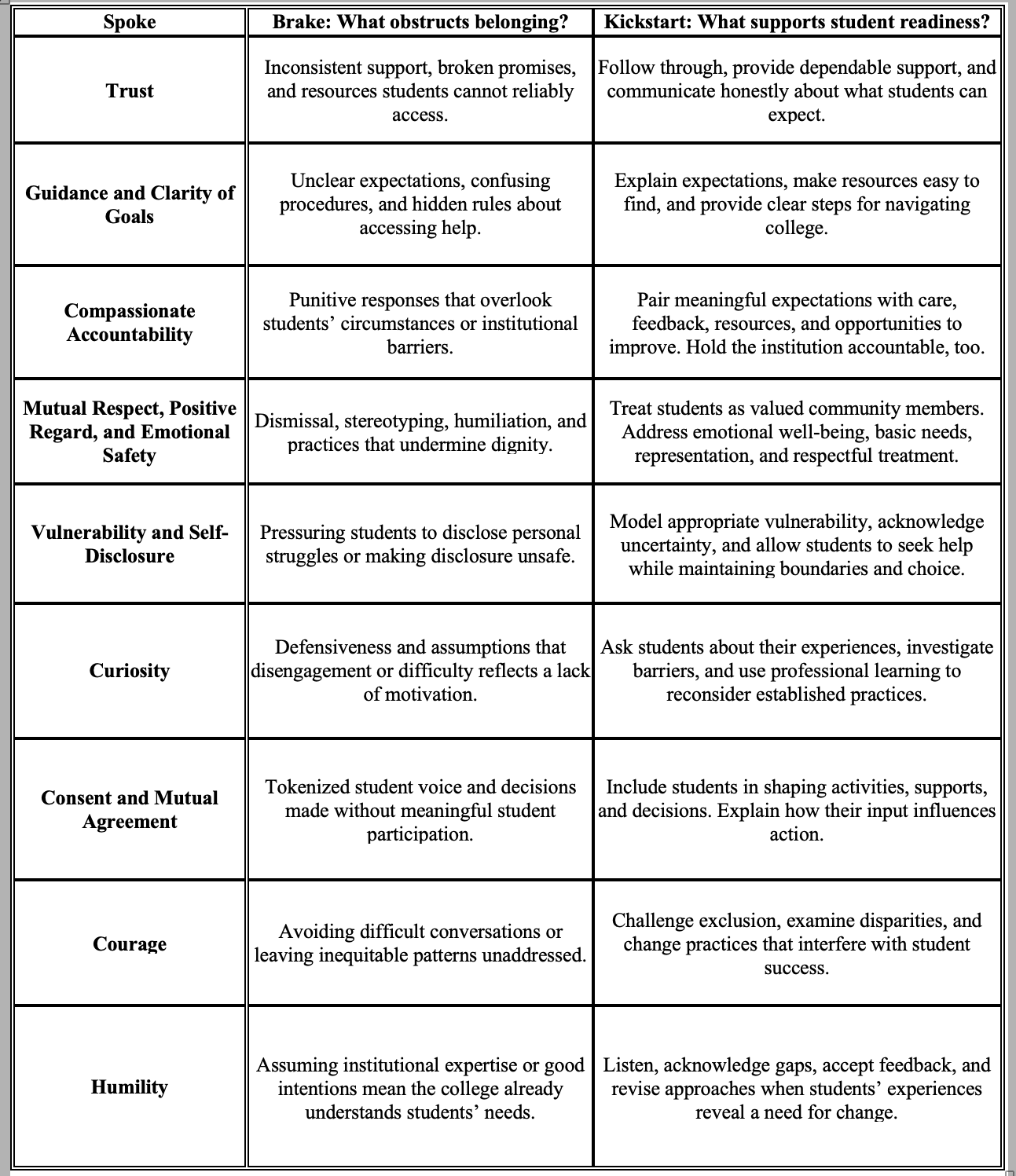
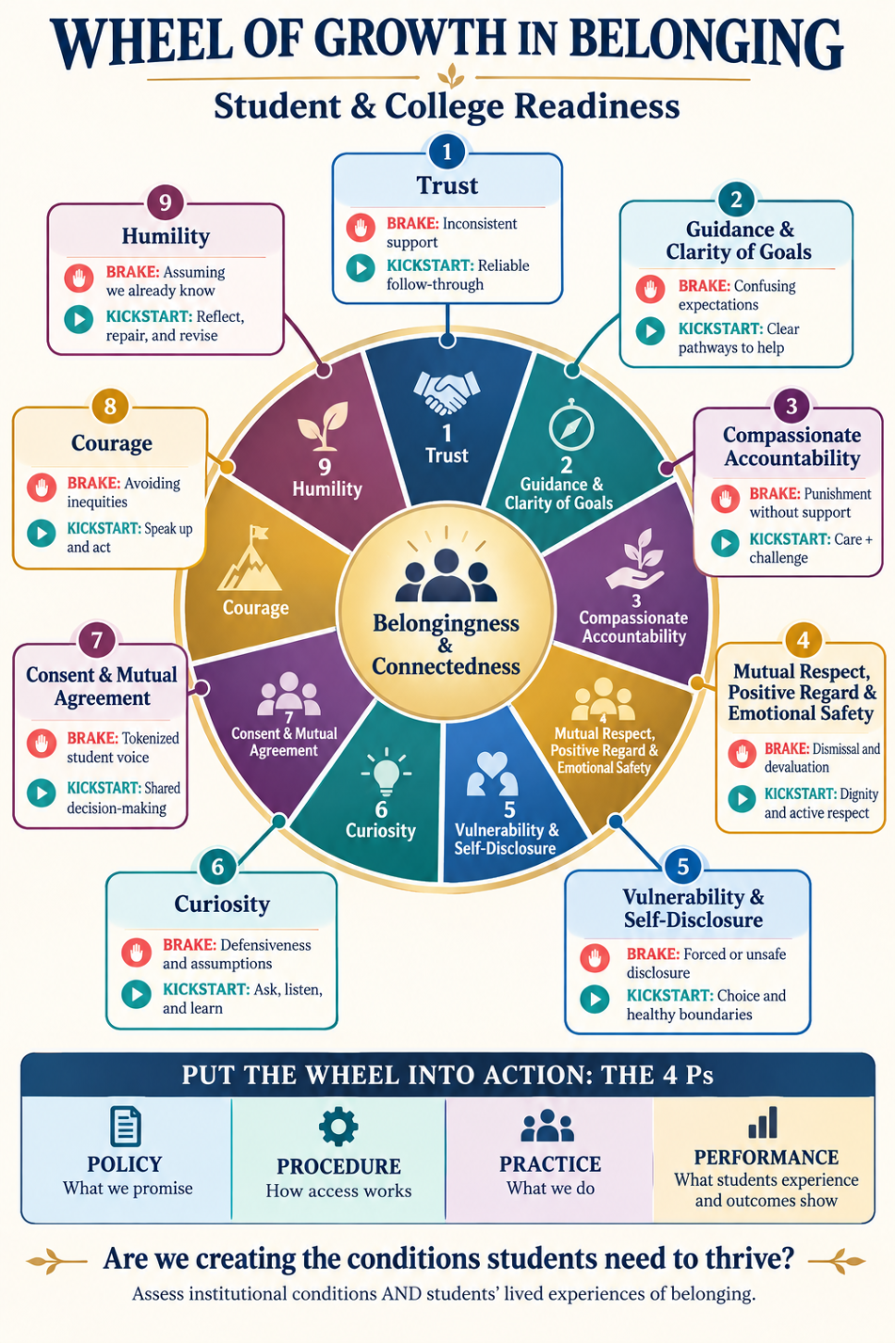
My Wheel of Growth in Belonging offers a way to examine that question. At its center are belongingness and connectedness, supported by nine interconnected spokes of the when, or conditions. These conditions invite us to examine what students experience through our policies, procedures, practices, and everyday interactions. Having supports in place is valuable, but we must also ask whether students actually experience acceptance, value, connection, and support.
Is the college concerned with the emotional well-being of its students? This question connects directly to Mutual Respect, Positive Regard, and Emotional Safety. Do students experience care in their interactions with faculty, staff, and administrators? Can they express a concern or ask for help without being dismissed, judged, or treated as an inconvenience?
Are faculty, staff, and administrators continuing to learn how to meet students’ belonging needs? This requires Curiosity and Humility. We must be willing to question our assumptions, listen to experiences different from our own, and acknowledge when our intentions do not match our impact. Professional learning should create opportunities to change how we teach, lead, and respond.
Does the college help students meet their basic needs? Food pantries, clean cafeterias, sanitary bathrooms, and accessible hygiene and menstrual products are concrete expressions of care. These practices can strengthen Trust when students can consistently access support without humiliation. Guidance and Clarity of Goals also matter: students need to know what resources exist, how to access them, and whom to ask. A resource that students cannot find or navigate has limited value.
Are there accessible opportunities to build connectedness? Bringing people together is a starting point. Consent and Mutual Agreement asks whether students have a meaningful voice in shaping those opportunities. Are we asking what connection looks like for them, including students who commute, work, or care for others? Or are we deciding for them and interpreting their absence as disinterest?
Do students see people who look like them throughout the organizational structure? Representation is an important first step toward visibility. Through Mutual Respect, Positive Regard, and Emotional Safety, we must also examine whether those represented are valued and heard. Through Courage, we must ask who has access to leadership, whose expertise carries weight, and what barriers we are willing to address.
Can the college serve as a practice field for psychological safety? Vulnerability and Self-Disclosure involves making room for people to acknowledge uncertainty, ask questions, and seek help while maintaining appropriate boundaries. Disclosure should remain a choice. Courage supports speaking up, and Compassionate Accountability allows us to hold meaningful expectations while offering care, feedback, and opportunities for growth. Students need room to make mistakes and support to learn from them.
The wheel also turns these questions back toward the institution. Compassionate accountability applies to the college itself. If certain populations of students are consistently not being retained or are not experiencing academic success, we must examine the conditions contributing to those patterns. Curiosity asks what we have missed, humility allows us to hear the answer, and courage requires us to act. The Wheel of Growth in Belonging gives us a way to move from expressing concern to examining institutional responsibility. We must ask where our practices strengthen the conditions for belonging, where they create barriers, and whether students’ experiences reflect the care we believe we provide.
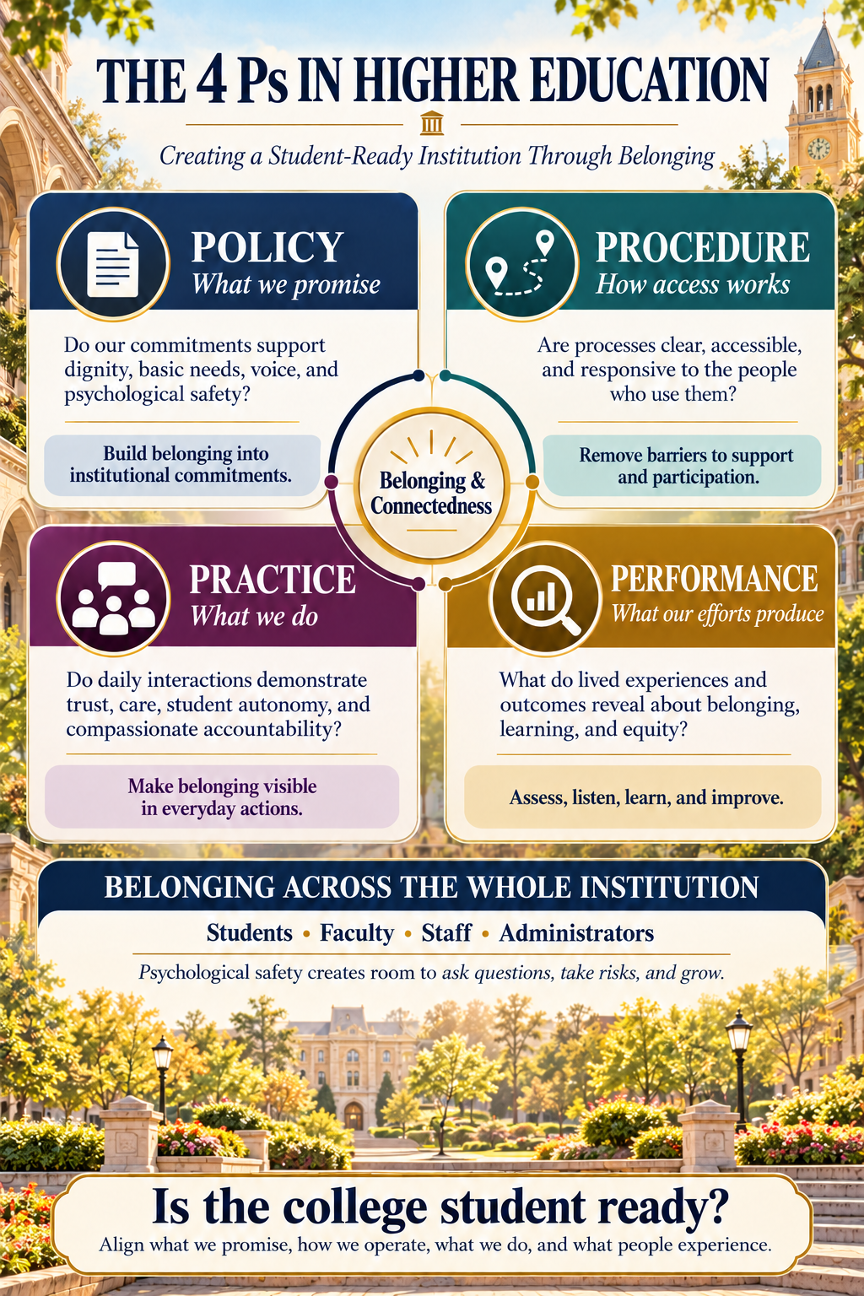
The Wheel of Growth in Belonging tool in conjunction and my 4 Ps model (Policy, Procedure, Practice, and Performance) both provide useful ways of measuring and assessing student and college alignment in readiness. Together, they help us examine the conditions the college creates, how those conditions are experienced, and whether institutional commitments translate into meaningful support.
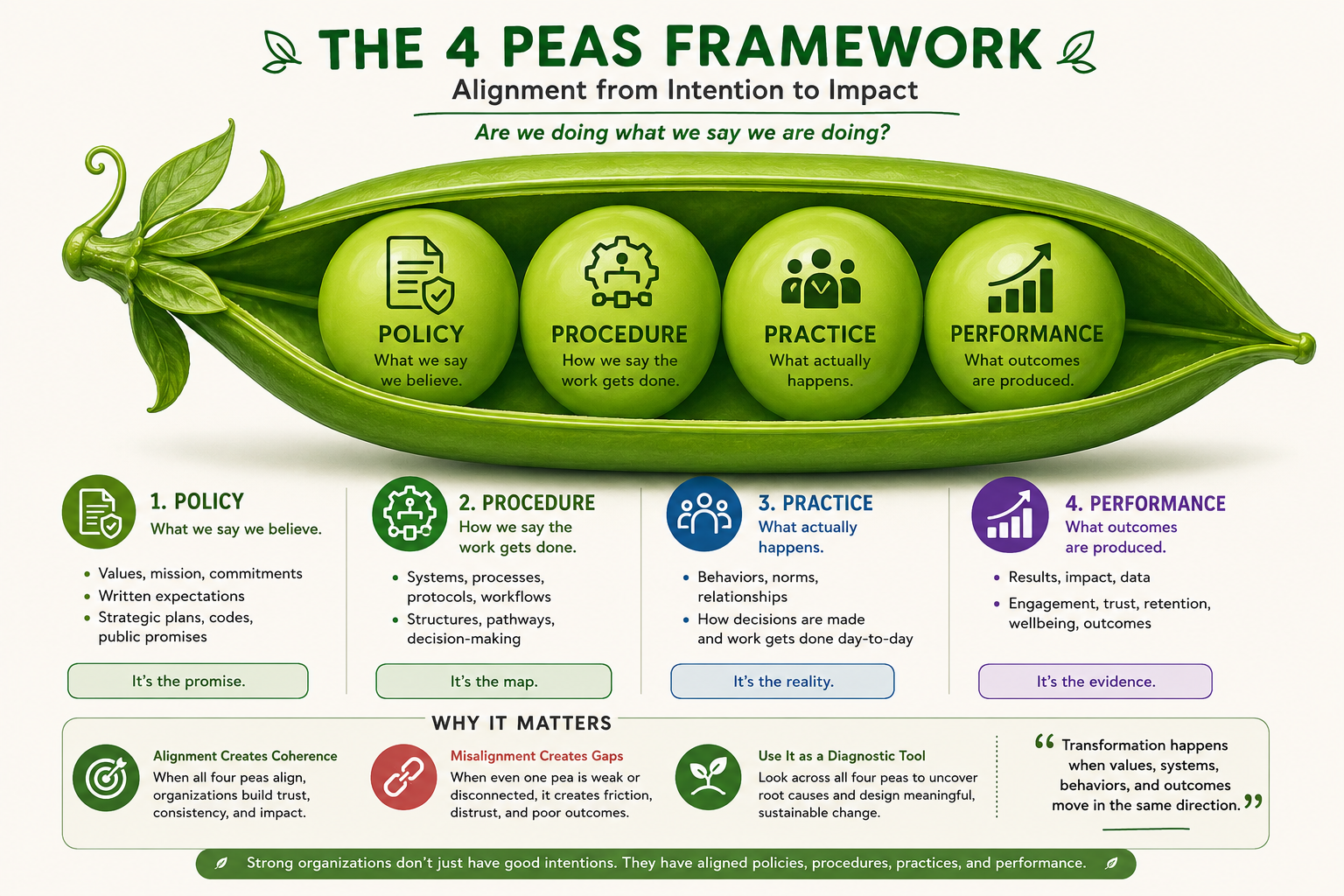
Policy asks what the college formally commits to. Do its policies support students’ basic needs, emotional well-being, dignity, and opportunities for belonging?
Procedure asks how students access those commitments. Are the steps clear, accessible, and responsive to the realities of students’ lives? What must students navigate to receive help?
Practice asks what actually happens in everyday interactions. How do faculty, staff, and administrators enact care, communicate expectations, respond to concerns, and include students in decisions?
Performance asks what those efforts produce and how we know. Do students report feeling valued, supported, connected, and safe enough to participate? What patterns emerge in retention, academic success, and access to opportunities across student populations?
The Wheel helps us examine the relational conditions that support belonging. The 4 Ps help us assess how those conditions are embedded throughout the institution. We must examine both: a policy can promise care while a procedure makes support difficult to access, and an individual can practice care within a system that continues to create barriers.
Together, these models move the question of readiness toward shared responsibility. We can consider what students need to succeed while also assessing whether the college’s structures and relationships make that success possible. When gaps persist, we must be willing to examine the alignment between what we promise, what we do, and what students experience.
Those Who Create Belonging Must Experience It Too
This focus on students and the environment is important to consider. Additionally, I continue to argue that the belonging experiences of faculty, staff, and administrators also shape student experiences. The people responsible for creating the conditions for student belonging need to experience those conditions themselves.
If we expect faculty to try different teaching strategies, staff to question procedures that create barriers, and administrators to reconsider established policies, they must feel psychologically safe enough to take those risks. They need room to ask questions, acknowledge uncertainty, challenge assumptions, and learn from approaches that do not work as intended. These are the same conditions we want them to create for students.
This is where the Wheel of Growth in Belonging extends across the institution. Trust, clarity, compassionate accountability, mutual respect, emotional safety, vulnerability, curiosity, consent, courage, and humility matter in classrooms, offices, departments, and leadership spaces. When employees experience defensiveness, punitive accountability, or limited voice, those brakes can also constrain their ability to respond to students. When they experience support, meaningful participation, and opportunities to grow, they have more room to extend those conditions to others.
Becoming student ready therefore requires attention to how faculty, staff, and administrators are supported in exercising professional judgment. They need opportunities to recognize and support students’ autonomy, invite students into decisions about their learning, and pair meaningful challenge with guidance toward mastery. Supporting autonomy does not remove expectations; it gives students an active role in understanding, pursuing, and demonstrating their learning.
My 4 Ps model helps us examine whether this commitment holds throughout the institution. Do our policies support voice and professional judgment? Do our procedures make experimentation and collaboration possible? Do our everyday practices communicate trust and compassionate accountability? Does our performance assessment examine both employee and student experiences, alongside the outcomes we hope to achieve?
We cannot place the responsibility for student belonging on faculty, staff, and administrators without examining whether the institution creates the conditions they need to carry out that responsibility. Becoming student ready requires an environment where the people supporting students also feel safe enough to learn, take risks, and grow.
©JMO, November 6, 2026