
The Weight of What Remains
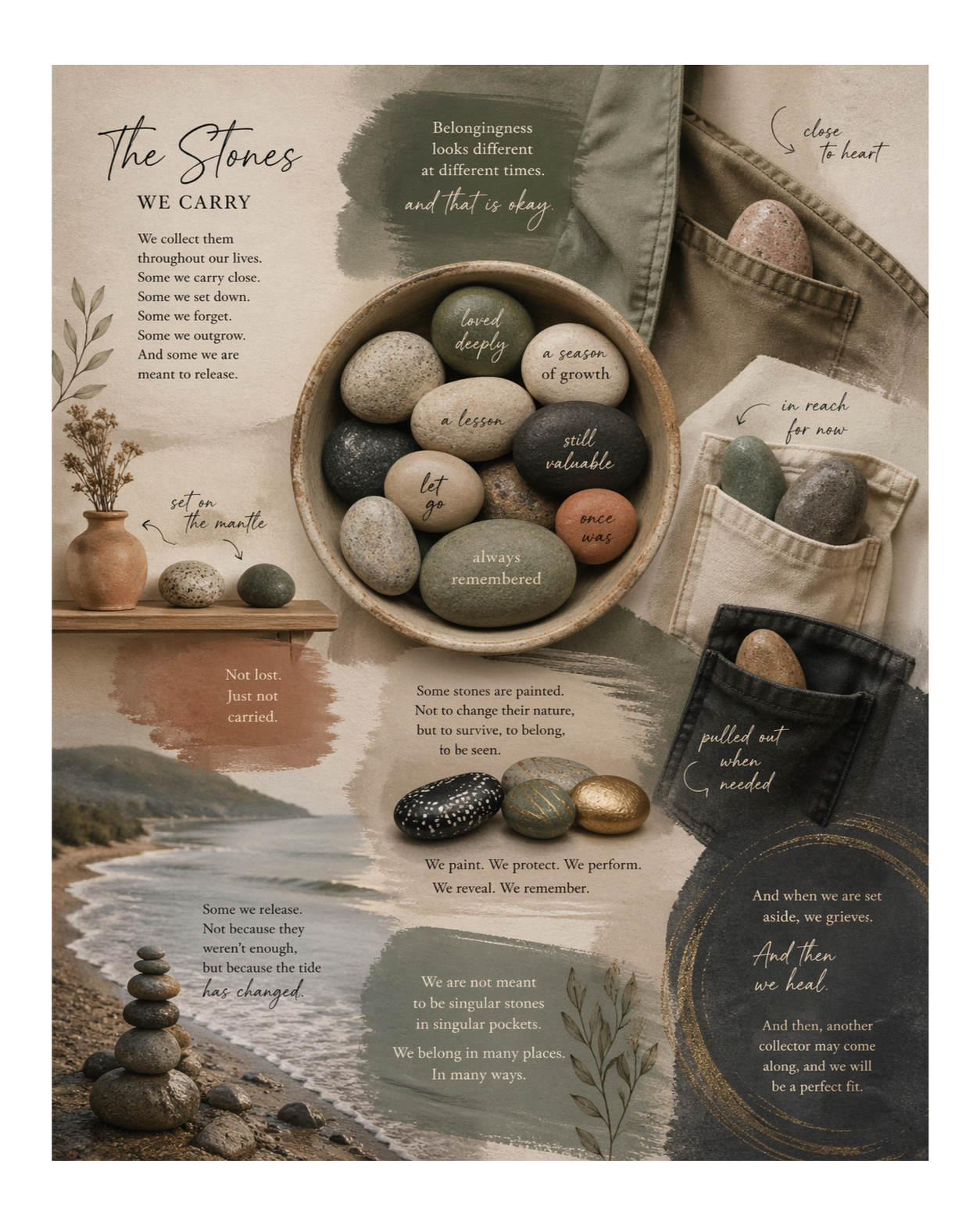
The Stones
One conversation that I frequently have with clients is about grieving the loss of a relationship. Sometimes this relationship is a romantic relationship, or a family member, or a platonic relationship, or a job, or a pet. The truth of it is that the grief always looks similar. The loss of relationship, the loss of connection, often looks the same regardless of the type of relationship. The analogy that I use I’ve called “The Stones Analogy.”
From the moment we are born, we begin to pick up stones and put them in our pockets. Some of the stones we carry in our breast pocket, close to our hearts. Some of the stones we carry in our side pockets, as though they are tucked into cargo pants. Some of them we carry in our back pockets, pulling them out only when necessary. However, throughout our entire lives, we are gathering stones.
But I encourage us to think about how heavy life would be if we continued to carry all the stones we have ever had in the same place. Imagine how heavy it would be to carry all the stones, all the relationships that we have ever had, all the people that we have ever met, along with us for our entire lives. It would be impossible. The fabric would tear. The seams would split. We would stop moving altogether.
So inevitably, we lose some of the stones. Sometimes we lose stones purposely, or we take them and set them aside and walk away. Sometimes we take the stones and place them on the mantle, to look at every now and then, to engage with every now and then. Still valuable, just not carried with us at every waking moment. Some stones we give away to someone else. Some stones we forget we had. They’ve simply fallen out of our pockets, and we don’t remember until we come across a stone that reminds us of that one. And then we remember, “Oh yeah, I used to have a stone that looked like that,” and we think of it fondly.
Sometimes, when working with couples or people who have experienced infidelity or disconnection in their relationship, I give the same analogy and suggest that sometimes the person we value so much is placed on the mantle, admired from a distance, while we choose to play with the less valuable stones within our immediate reach. Stones we can roll between our fingers without consequence. Stones that do not ask anything of us.
But how does the stone on the mantle know that it is valuable if the only stones that are touched, held, and engaged are the ones closer to the ground? The ones we step over. The ones we barely notice. Value, in that sense, is not only about where something is placed, but how often it is held. Value, in this way, is measured by connection.
Another way that I use this analogy is to say that sometimes our stones are valuable, and we may not see the value. So instead, we paint them to be what we want them to be. We sand and smooth over their edges, choose colors that feel more acceptable, more recognizable, more aligned with what we think value is supposed to look like. That painting of the stone is what we then show off. We hold it out and say, “Look at this hand-painted stone.”
But in doing so, it hides the innate value that lies within the stone itself. The original texture. The weight. The history of how it was formed. The quiet ways it already held meaning before we ever altered it.
On the flip side, sometimes the stone has no real value in the way we are trying to define it. And yet, we paint it with gold, or with metallic spray paint, attempting to pass it off as something precious. Something rare. Something worth keeping at all costs. But the nature of paint is that it does not integrate. It sits on the surface. And so, any scratch, any crack, any moment of pressure reveals the true nature of the stone underneath. The illusion becomes harder to maintain. The performance begins to fracture.
This is less about the nature of the person. This is not a statement about the value of the person. It is instead about the function of the relationship.
• Am I painting this relationship to be valuable when it is not?
• Am I painting this relationship to be less valuable than it actually is?
• Am I mistaking presentation for substance?
• What is the innate virtue of the stone?
• And perhaps just as important, what would it mean to let the stone be seen as it is, without the need to alter it in order to justify keeping it—or letting it go?
There are so many ways that this analogy can be used to describe relationships. But either way, we are continuing to gather new stones. And so, the grief of loss is natural. It is inevitable. It is necessary. But it is also good. Because carrying all the stones we will ever have would be too heavy. It’s okay to lighten our load.
This week, a brand new client of mine extended this analogy and said, “But what happens when we carry the stone so close to our bodies that it becomes connected to us, that it becomes calcified and becomes a part of us?” I had never considered this. I had always assumed that stones could be removed quite easily. Even the stones that we care very deeply about could be set down.
But she extended this analogy in such a way that shook me. Because some relationships become so embedded into our skin that they are not easily removed. They are not easily set on the mantle. They are not easily shaken loose. They become calcified and connected to us, fused into our structure, shaping how we move, how we stand, how we breathe. And sometimes, removing them might even require surgery. Careful incision. Intentional healing. Time.
Another person this week, as we discussed this analogy, began to talk about the larger stones, the ones that appear as boulders, and the role that they play. Sometimes, I suggested, those stones serve as an anchor. She nodded, but then paused and asked, “But anchor to what?”
“Well,” I said, “an anchor can do one of two things. In one way, an anchor can ground us. It can keep us stable. It can keep us steady when the water gets rough. But in another way, an anchor can hold us in place and keep us from going where we are meant to go. It can keep us stagnant, suspended in one location long after the current has shifted.”
So then, evaluating this boulder that is being used as an anchor becomes important. What is the function of this anchor? Is it stabilizing, or is it restricting? And is it time to loosen the rope, to release the weight, to let the current carry you forward?
I love this analogy, and I think of it often in my own life. It allows me to be okay with changing relationships. It allows me to recognize that sometimes relationships have calcified into my body to the extent that removal is not simple, and that’s okay too. It allows me to analyze whether an anchor is grounding, stabilizing, or paralyzing.
This analogy gives me something to do with my grief. Not to push it aside, but to understand it, to sit with it, to interrogate it. It allows grief to become not just weight, but information. I can hold my grief of loss with such care and self-compassion.
This analogy also allows me to consider the idea of “reason, season, lifetime.” And I think about the common phrase, “no new friends.” I admit that I am not a fan of “no new friends” ideology. I want to continue to be curious about life and relationships. I want to continue to gather new stones, to turn them over in my hands, to see how they catch the light.
Because there is something beautiful about growing my rock collection.
But I also want to be okay when we have come to the end of a stone’s purpose.
I do not want my life to become heavy, attempting to hoard all the stones, all the relationships that I have ever had. I want to honor their purpose. Honor their beauty. None of the relationships were without purpose. None of the friendships, jobs, romantic partnerships, including my past marriage, my past jobs, my past friendships were without meaning. Each one shaped something. Each one left a vital imprint.
And every now and then, I can remember a stone and find value in it without needing to carry it or find it again. There is beauty that remains in the memory of it alone. That was its purpose.
This analogy also helps me to be okay when I am a boulder or an anchor for someone else. Sometimes in a way that is grounding. Sometimes in a way that is paralyzing. And if I, as a stone, have to be put down, there is grief in that as well. But that’s okay.
I am also okay with knowing that I am not always a stone that is carried in the front breast pocket. Maybe I am a stone that is placed on a shelf, pulled down every now and then, admired for its value, and then returned to its place. And that’s okay, because that is my place. That is my purpose.
Alternatively, for some, I am a stone that is carried close to their hearts. And for those relationships, I hope that the weight is not too heavy, that it carries warmth instead of burden, that the connection is felt. And for those people, that is my place. That is my purpose.
I also consider what it feels like to be a stone that is set aside, never to be picked up by that person again. That can feel like abandonment, isolation, fear, exposure—all of those vulnerable experiences that can feel deeply threatening. There is a particular kind of quiet in being set down. Not loud. Not ceremonial.
Just… absence.
But, I want to acknowledge that this is a different sort of grief as well. What do we do when we are the stone that is set aside and forgotten about? How do we heal from that?
I find myself wondering if that is okay, too. Or am I shape-shifting, contorting myself, smoothing my edges, trying to become a stone that is never put down? A stone that is always chosen. Always carried. Always within reach. And if I am doing that, at what cost? What parts of me are being sanded away in the process of trying to remain in someone else’s pocket?
If stones had feelings, I imagine that being forgotten would be grievous. Not just because of the loss, but because of what it might make the stone believe about itself. That it was not valuable enough. Not smooth enough. Not rare enough to be kept.
But then I wonder if it is by design. Being set down by one collector may not be a failure of the stone. It may be a recognition of fit. A recognition of season. A recognition that what was once carried with intention is no longer meant to be held in the same way.
And perhaps there is something protective in that. Because to remain in a collection where you no longer fit may require constant reshaping. Constant proving. Constant negotiation of your own form.
So maybe being set down is not only loss. Maybe it is also release.
Maybe it creates the conditions for a different kind of belonging.
Because stones do not lose their inherent nature when they are set aside. They do not become less themselves simply because they are no longer being held by a particular person. They remain what they are, formed over time, shaped by pressure, carrying their own internal structure whether or not anyone is there to recognize it.
And in time, another collector will come along. Not to assign value, but to recognize it. Not to reshape the stone, but to receive it as it is.
In this way, there is grief. And there is also subsequent healing.
And perhaps both can be true at the same time.
I think you can gather from this analogy and exploration that I am not someone who believes that stones should be singular. That there is only one stone to carry, or one place where a stone belongs. I hope you also gather that I deeply believe in the value of belongingness.
And belongingness is not fixed. It is not static. It is not something we arrive at once and hold forever without change. Belongingness shifts. It expands. It contracts. It reorganizes itself across time, across context, across relationship.
A stone may belong in one pocket for a season and on a mantle in another. It may be carried close to the heart in one relationship and held at a distance in another. It may be set down entirely, not because it has lost its value, but because its place has changed.
To believe in belongingness, then, is not to believe in permanence. It is to believe in movement. It is to trust that connection can exist in different forms without requiring the same proximity, the same function, or the same expression at all times.
And perhaps more importantly, it is to trust that belonging is not diminished simply because it looks different than it once did.
We are not meant to be singular stones in singular pockets.
We are part of many collections, across many hands, across many seasons.
And each version of belonging, when it is honest, carries its own kind of truth.
Questions to ponder about community:
1. Are you gathering stones, or are you hoarding stones?
2. Have we become so heavy that we are now afraid to gather new stones?
3. Are you carrying stones that serve as anchors for grounding?
4. Are you carrying stones that serve as anchors that are paralyzing?
5. Are you carrying stones within your rock collection that have no value, that may be best suited to leave behind because they have become too heavy?
6. Finally, are you carrying stones that have been so calcified onto your body that you don’t know where the stone ends and where you begin? What would you like to do with that stone? The decision to keep it as is is valid and understandable. The desire to remove it is valid and understandable. And perhaps, for some stones, the work is not removal at all but learning how to live with its weight in a way that no longer harms you.