
When the Classroom Goes Quiet
One of the major challenges I have personally had in teaching over the past few years is student engagement. I am always attempting to create intentional spaces of belonging and inclusion where students feel free to share, challenge, and question.
Each day, I enter the classroom and play music. Some songs are my own favorites. Others come from students. On the first day of class, I ask about their favorite music, tying it to how our likes and dislikes are shaped by culture to provide an immediate way of thinking sociologically. However, the task is multipurposed. If a song is appropriate or somehow related to the lecture, I play it. On some level, I develop a new playlist each academic semester.
Additionally, because I am more concerned with engagement than with how students take notes, I bring a box of fidgets, coloring pages, crayons, and colored pencils. Students can use them while we are all engaging in the sociological conversation.
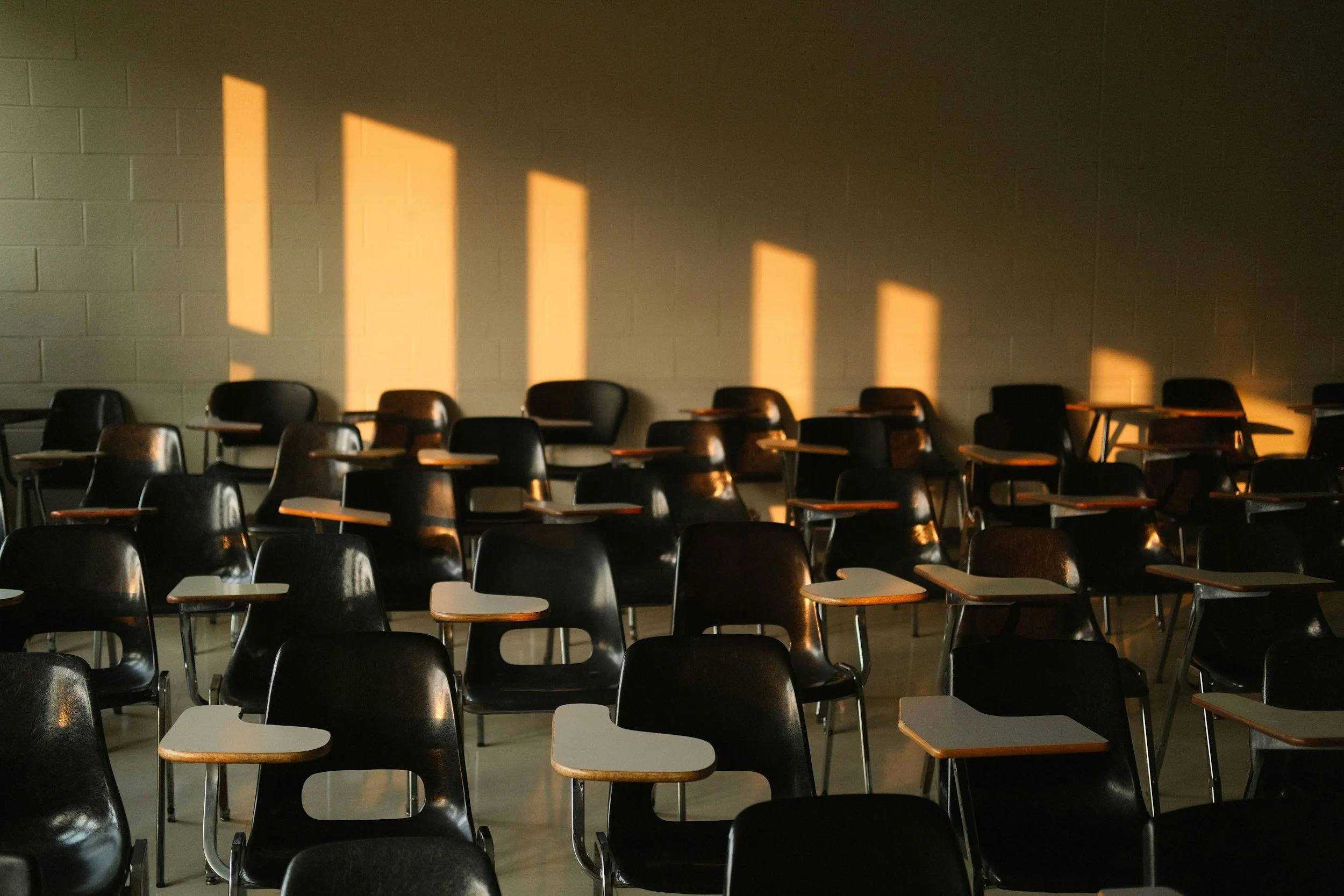
This semester, however, I was met with a significant challenge. There were few head nods. Students did not answer questions. There was very little visible expression, only blank stares. In week two, I asked the class why they were being so quiet. One brave student eventually said they were afraid of getting things wrong.
I attempted to assure them that this is a place to challenge and a space to question. I want to know how they are engaging with the world around them and how they are engaging with the material. During our first class, I had also asked how they wanted the class to operate, how they learned best, and what would make it more engaging. Resoundingly, these same students said they wanted small-group discussions, large-group discussions, and opportunities to engage hands-on with the material.
By weeks two and three, I was stumped. What they had asked for, I was providing.
On one particular day, I wanted to end class with an Oscar-worthy rendition of Russell Crowe’s character in Gladiator, asking, “Are you not entertained?!” To be honest, there were days when I struggled to find my own motivation to take part. Teaching when students appear disengaged is incredibly exhausting. The days of the lecturer standing before a hall and offering a rousing monologue of what they know have, in my mind, long passed. That form of education does not universally lead to increased learning or knowledge retention.
And so, I experienced frustration. At the same time, I knew that engagement requires feelings of belonging and psychological safety. I also knew that my students could feel my frustration, and that experiencing it might lead to even more shutdown and silence. So, I decided that on the days when I expressed frustration verbally, it would end that day. The next time we met would be a brand-new day.
I made intentional efforts to speak to students by name. When one very quiet student missed a day of class, I sent her an email expressing that she was missed in the classroom. I tried to remember small things about students and began arriving 15 minutes early so I could chat with those who also arrived early. I learned about their lives and their hopes after completing the course.
One student was a ballet dancer, and we talked about her love of dance and my love of seeing my daughter dance. I learned that another student was part of a large sibling group. I learned about one student’s musical abilities, while a few others and I connected over sports. All in all, I learned that if I wanted to talk and write about belonging and psychological safety, it required a bit more work and effort from me. I was ready for the challenge.
During this time, I read an article about what people are calling the “Gen Z stare.” While I felt that I had been experiencing something like it for weeks, I did not know there was a name circulating for it or that others were discussing it as a pattern. From what I could tell, the phrase describes an interaction in which someone offers very little visible reaction: no head nod, no head shake, no inquisitive look, no smirk. Just an expression that is difficult to read.
That expression does not necessarily mean someone is disinterested. A student may be listening carefully, thinking deeply, or feeling uncertain about whether it is safe to respond. My challenge as a teacher is that I cannot easily see which of those things is happening. The familiar cues that help me read the context of a conversation are missing.
This became clearer to me after speaking with someone fluent in American Sign Language. She informed me that facial expressions are syntax and are vastly important in the Deaf community. Facial movements, head position, and other movements that are not made with the hands can carry grammatical meaning in ASL. They can help distinguish, for example, a question from a statement. The face is not simply showing how a person feels. It is helping to communicate what they mean. ASL educator Bill Vicars describes these as nonmanual markers.
That conversation stayed with me. I do not mean that my classroom conversations follow the grammatical rules of ASL. But it made me think about how much context we gather from a face. An inquisitive look might tell me to slow down. A raised eyebrow might tell me that a student wants to challenge an idea. A smile might tell me that an example has landed. Even a frown might give me an opening to ask, “What about that doesn’t sit right with you?” I look to faces to see lightbulb moments, annoyance, confusion, humor, or disinterest.
When those cues are difficult to see, and silence is added, the communication stalls. I pose a question and wait. No one answers. I cannot tell whether students need more time, a different explanation, a smaller group, or reassurance that it is safe to get something wrong. How do we know how to respond when such a vital part of the context seems to be missing?
From a sociological perspective, we are interested in interactions and how we interpret them. There is a popular claim that 93% of communication is nonverbal and only 7% is found in words. That claim takes findings about a narrow kind of communication, judging feelings and attitudes when cues conflict, and applies them to communication in general. It is not a formula for every conversation. Still, facial expressions, tone, gesture, and timing help us interpret what another person means.
There is a Key & Peele skit in which two people communicate by text. One believes he is inviting the other person for an outing, while the other interprets the exchange as an invitation for a brawl. The skit is funny because many of us have experienced miscommunication when we cannot hear someone’s tone or see their expression. We search for context, and when it is missing, we fill in the blanks.
In the classroom, I do not want to fill in the blanks incorrectly. An eye roll or a look of disgust is hardly the response I hope for, but it gives me information. At least I can ask what is not landing. An expression I cannot read, paired with silence, leaves me guessing.
And yet, while silence may feel unnerving for the passionate college professor, silence does not always indicate disinterest or disengagement. That realization made me step back from the immediate discomfort of a quiet classroom and think about how schooling operates within systems of power.
The student relies on the expert professor to tell all. The professor is positioned as the person who knows, while the student is positioned as the person who has come to receive that knowledge. Within this system, the student may be led to believe that their own knowledge is not valuable—or at least that it is less valuable than the answer the professor already has in mind. When a professor asks a question, the student may hear something other than an invitation to explore. They may hear a test: Can I produce the answer the expert wants?
My student had already told me that they were afraid of getting things wrong. I had responded by saying that our classroom was a space to question and challenge. But my words alone could not undo everything they had learned about what happens when a student speaks and an authority figure decides whether the response is correct. Creating the conditions for conversation requires more than asking a question. It requires attending to the power within the room and giving students repeated experiences of being heard.
I also began thinking about the ways we have traditionally recognized engagement. Note-taking used to be one visible way engagement happened. The expert talked, and the student engaged by writing. Writing is not all the way passive. A student who takes notes may be selecting ideas, making connections, marking confusion, or putting a thought into their own words. Of course, a full page of notes does not prove that someone has understood the material. But it gives the professor something visible to recognize as participation in the learning process.
As students take fewer notes, one of those visible signs becomes less common. Engagement may then be measured by conversation: Who answers? Who asks a question? Who joins the discussion? But if the conversation is not happening, what signs of engagement does the professor have?
The assumption can quickly become that engagement itself is not happening. That may be true sometimes. But it is hard to say that students are not acquiring information simply because I cannot see that acquisition in the moment. What has become difficult is measuring it while we are together. There is a difference between learning not taking place and learning taking place in ways I cannot yet observe.
I could respond to that uncertainty with a pop quiz. But a punitive tool does not necessarily give me the information I am seeking, especially if my goal is belonging and conversation. A quiz might tell me what students can recall under those particular conditions. It might also confirm the fear one student had already named: that participation in this classroom means being caught getting something wrong. If I want to understand how students are making meaning, I need ways for them to show me their thinking that do not turn every moment of uncertainty into a threat.
Reading about the “Gen Z stare” also made me think about the context in which many of my students have grown up. Most of the students I am thinking of were born between roughly 2006 and 2009. Smartphones, tablets, and computers have been normal parts of their lives from an early age. Many also spent important years of their education interacting through screens. I wonder how those experiences shape what feels natural in a classroom conversation. How do students learn when to signal that they are listening, confused, curious, or ready to speak? How might those habits differ across settings?
These are questions, not conclusions about an entire generation. I cannot look at a student’s face and determine how much technology has shaped their way of communicating. I also cannot assume that one kind of visible response is the right kind for everyone. But I can ask whether the conditions of interaction have changed and whether my teaching practices need to change with them.
I also began thinking about mirror neurons. In research with monkeys, scientists identified neurons that respond both when an animal performs an action and when it observes a similar action. Research in humans suggests that observing and performing actions involve some overlapping brain systems. This gives us one way to think about how watching other people may help us learn and respond. It does not mean that mirror neurons, by themselves, explain empathy, facial expression, or what is happening in my classroom. The idea that newborn babies reliably imitate a caregiver’s facial expressions is also debated.
Still, the broader question interests me: how do we learn the back-and-forth of being with other people? I think about the small exchanges between a caregiver and a child—looking, responding, waiting, smiling, and noticing a response in return. I wonder whether having smart technology present from birth has changed some opportunities for face-to-face exchange. I am not suggesting that a caregiver looking at a screen is providing poor care. Caregivers have always attempted to multitask, and caring for a child involves far more than looking at them. I am wondering how our everyday patterns of attention shape the ways we practice reading and responding to one another.
A related thought is facial feedback theory. I am incredibly interested in how our bodies provide signals about what and how we feel. Facial feedback suggests that an expression can sometimes influence the feeling we experience. We may smile because we feel happy, and the act of smiling may, in some circumstances, contribute to that feeling. The relationship is not a simple command from the face to the brain. Our bodies and brains are in conversation with each other.
All of these thoughts come with me into the classroom when students offer me an expression I cannot easily read. In my therapist mind, I am curious about how to use the space and time to help students get back into their bodies and notice how they are feeling. Are they afraid of being wrong? Are they confused? Are they interested but uncertain about when to enter the conversation? What conditions would help them feel safe enough to let me know?
I am also thinking about how much learning relies on engagement—and what engagement necessarily means. In a private conversation with a student recently, I shared that engagement does not have to mean talking in front of the entire class. It might mean writing down a question, testing an idea with a partner, choosing an example, or noticing that something we discussed has challenged a long-held assumption. A head nod or a facial expression helps me recognize a response, but I do not want to mistake the absence of a visible signal for the absence of thought.
At the same time, a classroom is an interaction. When I ask a question and meet silence, I need some way for us to move together. Perhaps I can ask students to write first and then share what they are willing to share. Perhaps I can ask them to identify the part of an idea they are still considering. Perhaps I can say aloud, “I cannot tell whether you need more time or whether I need to explain this another way.” Each of these gives us another way into the conversation without requiring a student to begin by risking a public wrong answer.
So, what do we do with all of this? How do we think about it from psychological, sociological, and systems perspectives? How do we recognize engagement when some familiar signs are missing? How do we find out what students are learning without making the classroom feel more punitive? What tools do we have to invite nonverbal participation and create safety for verbal participation?
What I am seeing feels bigger than a challenge in education. It raises questions about how we read context, how we respond to silence, and how systems of power shape who feels entitled to speak. I do not know exactly what these changes mean for the future. But I know that if I want to create the conditions for belonging, I cannot assume that silence means nothing is happening. I have to remain curious about what my students know, what they are experiencing, and what it will take for us to keep the conversation moving.