
The Water
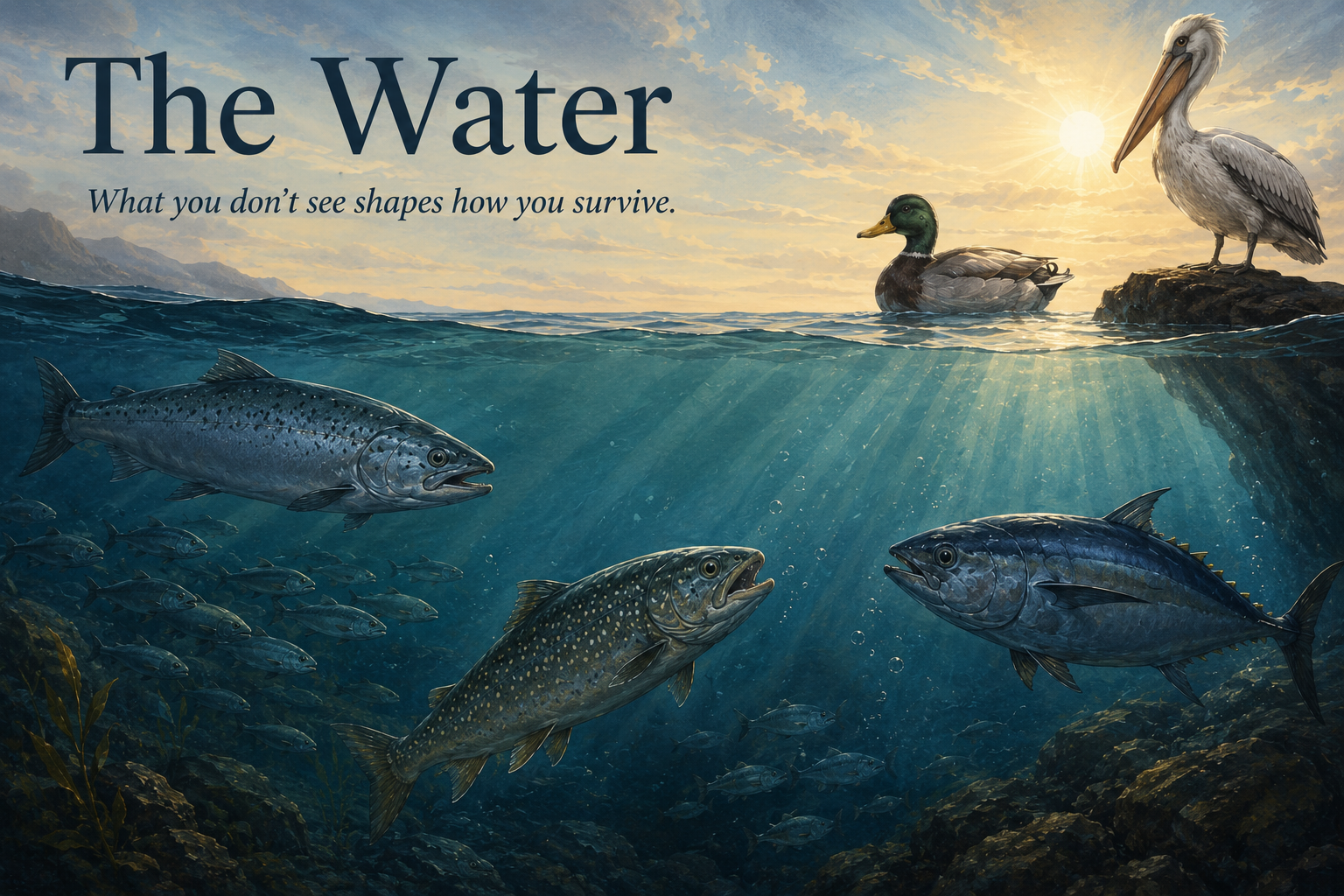
The Water: What you don’t see.
Fred the Salmon had never wondered about the water.
Of course, why would he?
It had always been there. It held him, carried him, fed him, surrounded him. Every memory he possessed had taken place within it. Every story his parents told him happened in it. Every lesson about life assumed it. The water was so ordinary, so constant, so thoroughly woven into existence that was invisible.
The water simply was.
It was not something to observe. It was not anything to be curious about. It simply was reality itself.
One morning Fred crossed paths with Tommy Tuna.
"Did you hear about the new neighbor?" Tommy asked.
"The one from the lakes?"
Tommy nodded. "Apparently he's having a terrible time breathing."
Fred frowned.
"Strange."
"I know," Tommy replied. "I've never heard of a fish having trouble being a fish."
Fred laughed.
"Maybe he's just weak."
"Or maybe," Tommy added, "lake fish just aren't prepared for real life. You know? There is something about being from the lakes, right? It’s like they are not prepared for real life!"
The two continued swimming. Neither questioned the water.
They only questioned the fish.
It never occurred to either of them that what felt natural to them might not be natural for everyone.
Luka the Lake Trout had spent his entire life in cool freshwater lakes and rivers.
Like every other fish, he had never noticed the water there either.
Why would he? He had never needed to.
Freshwater simply surrounded him. It supported his body, filled his gills, and carried him through life. He never considered that his breathing depended not only upon having gills, but upon the kind of water flowing through them.
But one wrong turn changed everything.
The river widened.
The current strengthened.
Before long, Luka found himself in the vast ocean.
Within hours, something felt terribly wrong.
His gills burned.
His mouth opened wider and wider, searching desperately for a breath that never seemed to be enough.
Swimming became exhausting and simplest movements demanded extraordinary effort.
At first, Luka assumed something inside him had broken.
Perhaps his gills had become damaged.
Perhaps he wasn't trying hard enough.
Perhaps this was simply what strong fish endured.
But as the days passed, he considered another possibility.
What if nothing was wrong with his body?
What if something was different about the place?
“What if…” he wondered, as that wrong turn flashed in his memory.
For the first time in his life, Luka became aware that survival depended not only on who he was, but also on where he was.
And or the first time...
...he noticed the water.
Confused, Luka swam toward the surface where Devin the Duck floated peacefully in the afternoon sun.
"Excuse me," Luka called.
Devin looked down.
"Yes?"
"Why can't I breathe?"
Devin didn't answer immediately. He thought this fish looked out of place. Having never seen a lake trout in this part of his travels, he asked, "Where are you from?"
"The lakes."
Devin nodded knowingly. That made sense. "The water is different here," he encouraged.
Luka blinked. "The what?"
"The water."
Luka looked around.
"This?"
"Yes."
"It's making it hard to breathe?"
"Well,” Devin paused, “For you."
Luka stared silently.
No fish had ever spoken about water before.
Just then Fred the Salmon and Tommy Tuna swam by.
"Luka's asking about the water," Devin called.
Fred laughed. "What the heck is water?"
Tommy smiled. "There is no such thing as water. This is just reality."
Luka looked from the duck to the fish.
Someone had to be wrong. His gills were still burning.
Word spread quickly throughout the ocean.
The new fish kept talking about water.
Many fish found him exhausting.
"Everything isn't about the water," muttered, Edna the Red Drum, as rolled her eyes with exasperation.
"Maybe his gills just aren't very strong," agreed Gary the Red Drum, while offering an alternative explanation.
"If he spent less time complaining and more time adapting, he'd be fine,” offered Blu Fisch.
Others offered encouragement that wasn't really encouragement.
"Give it time."
"You'll get used to it."
"We all had to learn."
No one asked what the water was doing to Luka.
Everyone asked what was wrong with Luka.
The more he described his experience, the more certain the other fish became that his problem must lie within him.
The water remained unquestioned. And Luka’s gills stilled burned, scarring a bit around the edges.
Months passed and Luka slowly learned to survive.
Not because the water had changed.
But because he had.
His body adapted.
His breathing improved.
Or rather, he wondered if he had just adapted an grown accustomed to the pain, adapted to not breathing, forgetting what breathing was supposed to feel like.
Forgetting what it meant for his gills to not burn.
He learned where the gentler currents flowed and discovered places where the salt felt slightly less harsh.
Survival was possible.
BUT.
Comfort never felt attainable.
Many ocean fish mistook his adaptation for proof that nothing had ever been wrong.
"You see?" Fred said one afternoon.
"You just needed to adjust."
Luka smiled politely, wondering whether adapting to pain caused fish to forget that it had once been painful.
As the months turned into years, Luka met creatures from every corner of the ocean.
He spoke with turtles who traveled enormous distances.
Octopuses who disappeared into places no one else noticed.
Fish from warm waters.
Fish from cold waters.
Fish who lived near predators.
Fish who lived near reefs.
He spent long afternoons talking with Devin the Duck and Penelope the Pelican.
At first Luka assumed the birds understood the ocean best because they could leave it.
Over time, he realized that wasn't quite true.
The creatures who understood the water most deeply were not necessarily those who spent the least time in it.
They were the ones for whom the water demanded the most.
The ones who understood were the those for whom the salt was the least forgiving.
The ones who felt the punishing grit of salt but were told, it’s no one’s fault.
It’s just reality.
The fish whose gills burned noticed subtle changes in salinity before anyone else.
The fish forced into dangerous currents learned to read movements invisible to others.
The fish who spent their lives avoiding predators could interpret the faintest shadow passing overhead.
Their survival depended upon understanding the water.
Comfortable fish rarely developed these skills.
They didn't need to.
One afternoon Luka shared this realization with Devin. "I thought the creatures outside the water understood it best."
Devin smiled.
"I can describe the water, but I don’t experience it." He looked carefully at Luka. “You experience it and can tell me what the water does."
The distinction stayed with Luka.
Perhaps discomfort was not ignorance.
Perhaps it was education.
Perhaps survival was also a teacher.
And perhaps that explained another mystery.
The fish who benefited most from the water often knew the least about it.
Not because they were unintelligent.
Not because they lacked curiosity.
But because the ocean rarely required them to study the conditions of their own success.
The currents carried them where they wanted to go.
The salt fit their bodies.
The water asked very little of them.
The water did not even ask that they understood themselves.
And so they didn’t.
The fish struggling to survive spent their lives studying the water.
The fish thriving within it often spent their lives studying those who had trouble in the water.
For these fish? Trouble was a visible indicator of deficiency in others.
Water was made up.
Reality just was.
And one group learned adaptation.
The other learned confidence.
Only one was required to understand the ocean.
One afternoon Fred the Salmon drifted alongside Penelope the Pelican.
"You birds have it easy," he remarked.
Penelope laughed.
"Easy?"
"You don't have to deal with the ocean."
"I don't breathe underwater," Penelope responded with a side eye.
"But you can fly."
"I fly because I cannot survive underwater."
Fred shrugged.
"If you really wanted to, you could learn."
Penelope smiled sadly.
"Should everyone be judged by how well they swim? Even when they don’t have gills?"
Fred hesitated.
He had never considered another possibility.
Swimming was simply what competent creatures did.
When birds struggled underwater, fish blamed the birds.
Some pointed proudly toward penguins.
"See? Penguins swim,” they urged, as though the existence of one swimming bird erased the experience of every other bird. As though one exception disproved an entire pattern.
The water was deemed the standard against which every creature was measured.
The fish never noticed they had made it the standard.
The fish, using swimming as the yardstick by which goodness was measured found birds, who soared above them, to be lacking and deficient.
The fish, using swimming as a yardstick by which hard work was measured, looked at flight and said, “You have it so easy.”
Years passed.
More freshwater fish arrived.
Some came willingly.
Others by accident.
Almost all struggled.
Their gills burned.
Their scales cracked.
Their bodies tired long before the ocean fish did.
Their children suffered and were blamed.
Schools of Fish created disciplinary codes, claiming that they had to because the fresh water fish were too disruptive.
Medical practitioners said the cracked scales, trouble breathing and burned gills were a result of “lifestyle” and dietary choice.
Researchers said that the shortened lives were genetic predispositions.
Nothing could be done.
Yet many desperately wanted to remain.
The ocean represented opportunity.
Safety.
Status.
Respect.
Belonging.
Well… if they could change themselves and adapt to the burn.
Stories about the ocean traveled far beyond its shores.
Fish from rivers dreamed of reaching it.
Some believed life could not truly begin until they arrived.
"If I can just swim like them..."
"If I can just sound like them..."
"If I can just stop talking about where I came from..."
“Fresh water isn’t actually better…”
Some practiced ocean accents.
Some abandoned the customs of their rivers.
Some mocked newcomers before the ocean fish even had the opportunity.
Luka found this heartbreaking.
One evening he asked Devin why.
The duck watched the sun settle into the horizon before answering.
"Imagine spending your whole life trying to earn a place here."
Luka nodded.
"Now imagine discovering the water itself has been hurting you."
Luka remained silent.
"Some fish have paid too much to belong," Devin continued. “They've hidden parts of themselves. They've forgotten the songs their rivers taught them. They've learned to apologize for where they came from. They've convinced themselves the salt made them stronger. If they admit the water isn't neutral..." he paused, considering the heaviness. "Well. Then they must also grieve everything it cost them."
Luka looked across the ocean.
Some fish couldn't see the water.
Some saw it but refused to acknowledge it because acknowledging it meant acknowledging that the water had carried them.
Others defended it because they had sacrificed too much to imagine another way of living.
The ocean did not need every fish to love the water.
It only needed enough fish to mistake it for reality.
Eventually Luka gathered enough courage to speak publicly.
Fish from every corner of the ocean came to listen.
"I don't think the water is the same for everyone," he began.
Some fish laughed.
Others grew defensive. How dare Luka suggest that they had it easier? What even was water?
But a few became curious.
Fred the Salmon remained quiet.
For the first time in his life, he stopped paying attention to himself long enough to notice the water.
He noticed how effortlessly it held him.
How naturally it fit him.
How little it demanded from him.
Then he looked at Luka.
He noticed Luka breathing.
He noticed the discoloration of his gills and the effort of breathing.
Really breathing.
Every breath still required intention.
Every movement still carried effort Fred had never seen before because he had never needed to look.
For the first time, Fred tasted the salt.
Only faintly.
But once he noticed it, he could never completely stop noticing.
Years later, young fish would ask Luka what he had learned.
He never answered directly.
Instead, he would ask them a question.
"When a fish struggles to breathe, why do we always begin by examining the fish?"
He would wait.
Then ask one more.
"What if we started by examining the water?"
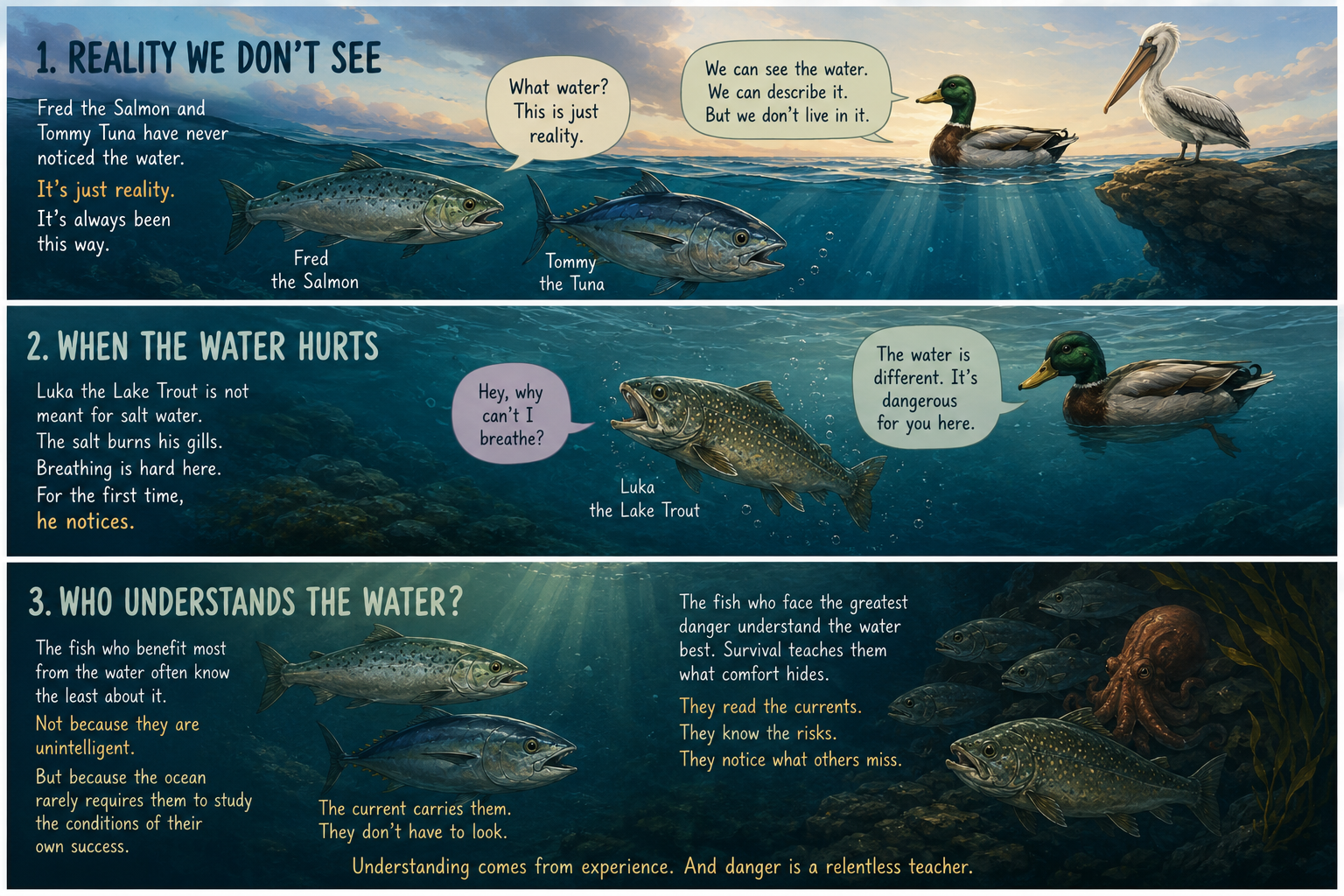
Understanding comes from experience. But first, we have to see it.
But of course, this story is not really about Fish.
This story is about Racism.